Tina Vogel · 18 November 2026
Atmospheric Humidity Gradients Altering Organic Preservation in Remote Marsh Sediments
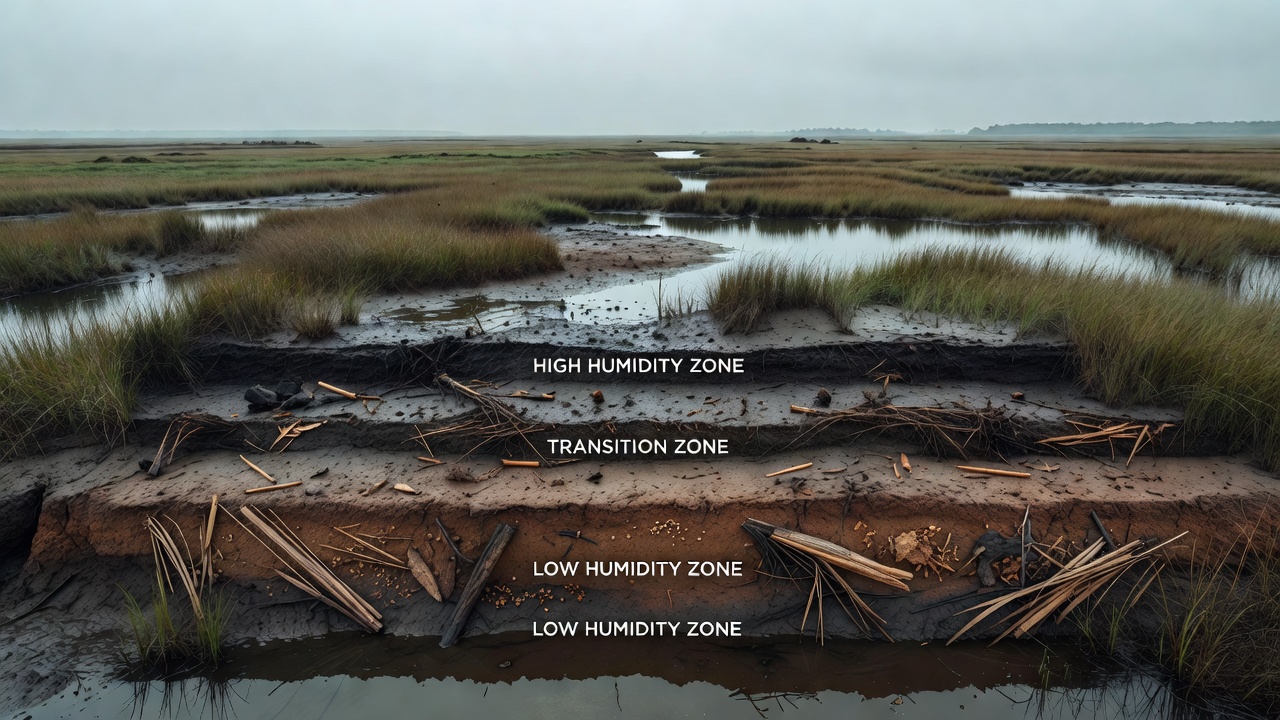
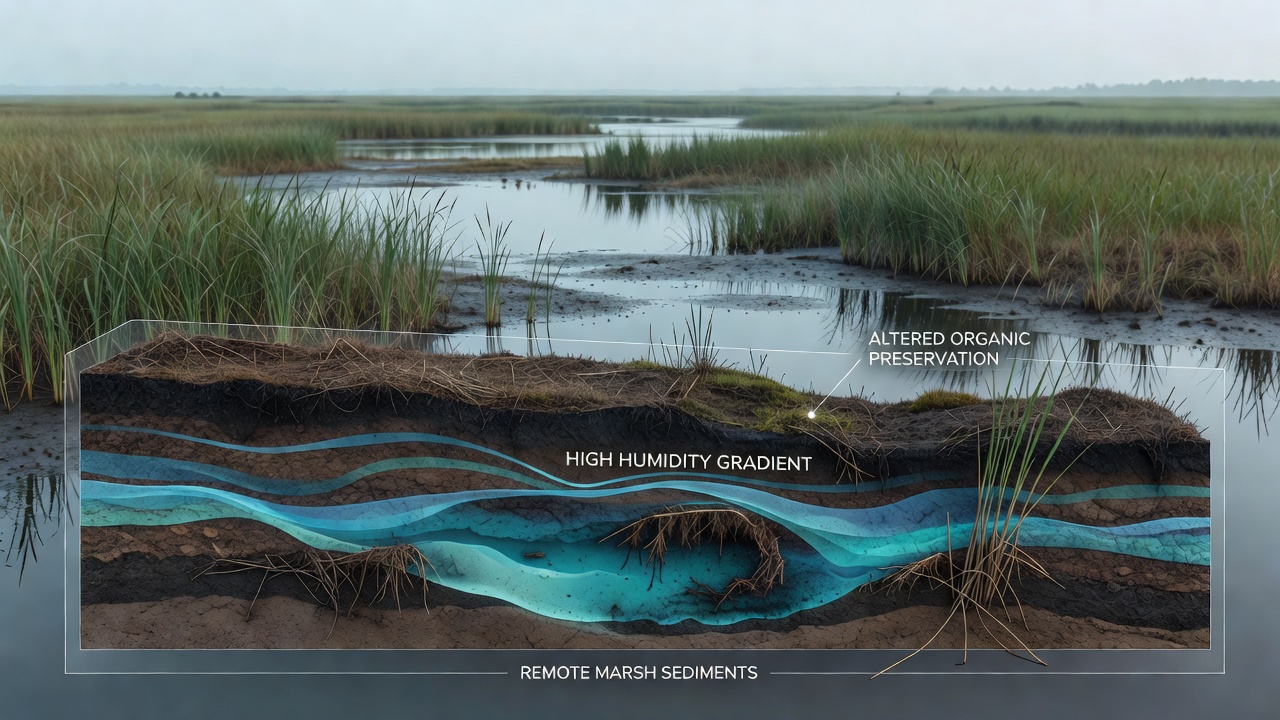
Atmospheric humidity gradients create distinct zones of moisture retention in remote marsh sediments where organic materials undergo differential rates of decomposition and mineralization. Researchers track these gradients through vertical and horizontal profiles that shift with seasonal vapor pressure changes, and the resulting patterns determine how plant residues and microbial biomass persist over centuries in isolated wetland basins. Data collected from multiple field stations show that steeper gradients correlate with sharper boundaries between well-preserved peat lenses and more oxidized upper layers, while gentler transitions produce broader zones of intermediate preservation states.
Mechanisms Driving Preservation Differences
Humidity levels control oxygen diffusion into sediment pores because higher vapor concentrations reduce the air-filled porosity that allows aerobic respiration to proceed rapidly. Anaerobic conditions develop more readily when relative humidity remains above 85 percent for extended periods, and this slows the breakdown of lignin and cellulose structures within buried plant fragments. Observers note that microbial communities shift composition along these gradients, with methanogenic archaea dominating in consistently moist pockets while facultative bacteria occupy transitional bands where humidity fluctuates daily. Studies of sediment cores reveal that organic carbon content can differ by 12 to 18 percent between adjacent sampling points separated by only 30 centimeters when humidity gradients exceed 15 percent per meter of depth.
Field Observations Across Isolated Sites
Teams working in northern boreal marshes and subtropical coastal wetlands have documented comparable effects despite geographic separation, and the consistency suggests universal physical controls rather than site-specific biology. In one long-term monitoring network, instruments recorded humidity profiles every six hours for five consecutive years, and the accumulated records show that nocturnal dew formation often steepens near-surface gradients during spring and autumn. These repeated measurements demonstrate that preservation hotspots form where humidity stabilizes above 90 percent for more than 200 days annually, whereas organic matter loss accelerates in layers exposed to repeated drying cycles below 70 percent. Sediment samples from such hotspots contain intact pollen grains and recognizable macrofossils at depths where surrounding material appears amorphous and mineral-rich.
Interactions with Temperature and Hydrology
Temperature and hydrology interact with humidity gradients to modify preservation outcomes because warmer air holds more moisture yet also increases evaporation rates when saturation drops. Researchers have measured synergistic effects in which a 2-degree Celsius rise combined with a 10 percent humidity decrease can double the oxidation rate of surface sediments even when deeper layers remain saturated. Hydrologic flow paths further redistribute dissolved organic compounds along gradient boundaries, and this lateral transport creates chemical signatures that researchers use to reconstruct past moisture regimes from isotopic ratios preserved in the sediments. Evidence from multiple catchments indicates that these combined drivers produce preservation mosaics rather than uniform layers, and mapping the mosaics requires dense sensor arrays rather than single-point measurements.
Developments Reported in November 2026
In November 2026 an international consortium released updated modeling outputs that incorporate real-time humidity data from satellite-derived vapor products into sediment diagenesis simulations. The new runs predict that continued increases in atmospheric water-holding capacity will extend the vertical reach of high-humidity zones in many remote marshes, potentially expanding the volume of sediment experiencing reduced decomposition by 8 to 14 percent over the next three decades. Validation datasets collected from Canadian Shield wetlands and Australian coastal plains show close agreement between modeled and observed organic carbon inventories, confirming that gradient dynamics exert measurable control on long-term carbon retention. The consortium also released open-access sensor protocols that allow smaller research groups to replicate the monitoring arrays at additional remote locations.
Broader Implications for Carbon Accounting
Accurate representation of humidity-driven preservation improves regional carbon budget calculations because traditional models often assume uniform decomposition rates across entire wetland classes. Revised estimates that account for gradient effects lower the projected release of stored carbon from certain marsh types under drying scenarios while raising estimates for marshes where humidity is increasing. Government agencies responsible for national greenhouse gas inventories have begun incorporating these spatial refinements, and preliminary adjustments appear in draft reports scheduled for release in 2027. The same refinements also inform restoration planning because sites with naturally steep gradients may require less intervention to maintain existing carbon stores compared with sites where gradients have flattened due to drainage or vegetation change.
Conclusion
Atmospheric humidity gradients therefore function as primary controls on organic matter longevity within remote marsh sediments through their influence on oxygen availability, microbial activity, and chemical transport. Continued monitoring and refined modeling will clarify how these gradients respond to ongoing atmospheric changes and will support more precise predictions of carbon storage across wetland landscapes.