Rosa Butler · 23 September 2026
How Fog Patterns Shape Peat Layers in Isolated Bogs and Their Impact on Carbon Storage Cycles
Isolated bogs form in depressions where water accumulates without significant surface inflows, and fog patterns supply the steady moisture that sustains the waterlogged conditions essential for peat development. These ecosystems depend on atmospheric inputs rather than streams or groundwater, which means fog frequency and density directly control how much water reaches the surface and how long anaerobic zones persist in the soil profile. Researchers tracking these sites note that fog events often occur in predictable seasonal cycles tied to temperature inversions and topographic sheltering, creating microclimates that slow evaporation and maintain saturation levels even during drier periods.
Fog Dynamics in Remote Bog Environments
Fog forms when moist air cools to its dew point, and in isolated bogs this process repeats nightly or during frontal passages, delivering liquid water that infiltrates the upper peat matrix. Studies from northern temperate regions show that advection fog and radiation fog differ in their droplet size distributions, with smaller droplets from radiation events penetrating deeper into moss layers before evaporating. Data collected across multiple sites indicate that bogs surrounded by forest cover experience prolonged fog retention because trees reduce wind speeds and trap humid air, whereas open bogs see quicker dissipation once solar heating resumes. These patterns vary by latitude and elevation, yet the core mechanism remains consistent: fog adds both water and nutrients that support Sphagnum growth while limiting oxygen diffusion into the peat column.
Peat Layer Development Under Variable Fog Regimes
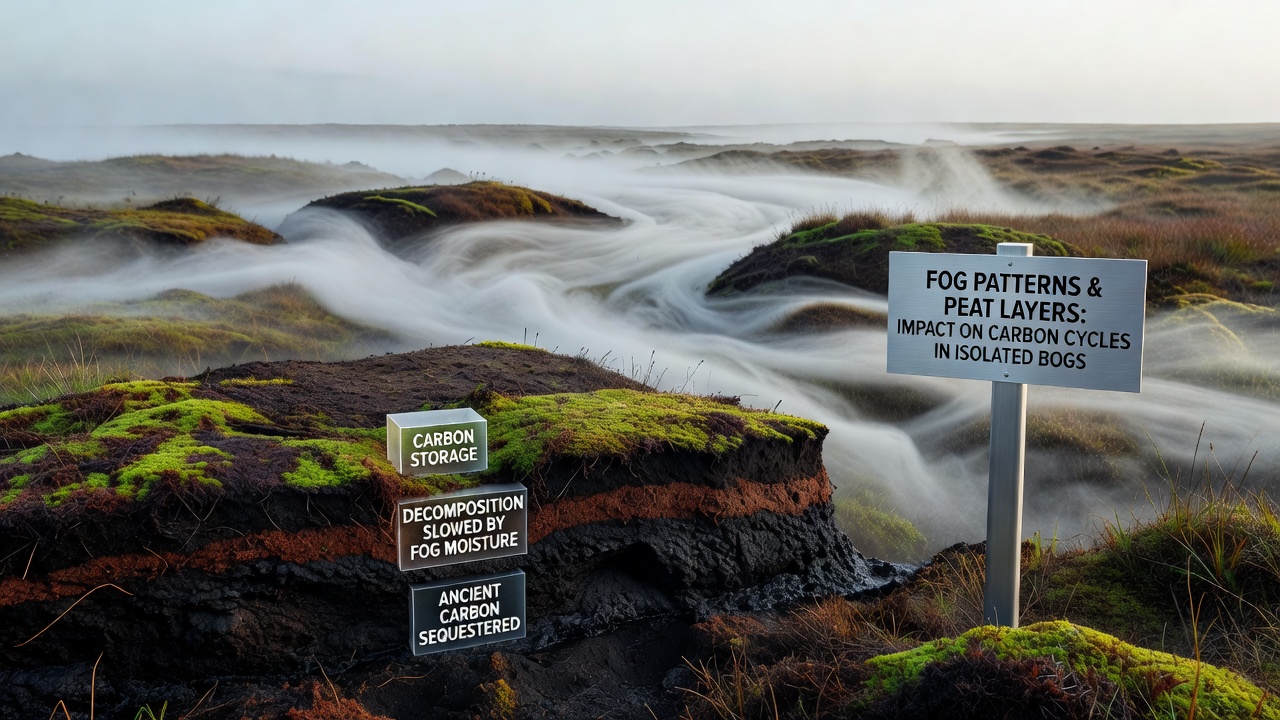
Peat accumulates when plant material decomposes slower than it is produced, a balance maintained by persistent anoxia that fog helps preserve through repeated rewetting. In years with high fog incidence the upper peat layers thicken faster because moss productivity rises and aerobic bacteria remain suppressed, whereas reduced fog allows partial drying that accelerates carbon mineralization at the surface. Core samples from several isolated systems reveal alternating bands of dense and fibrous peat corresponding to multi-year fog trends, with darker, more humified layers forming during drier intervals. Observers note that these stratigraphic markers provide a record of past atmospheric moisture, and current monitoring programs continue to link annual fog hours directly to measured accretion rates in the top 30 centimeters of the profile.
Carbon Storage Responses to Fog-Driven Hydrology
Carbon storage in peat depends on the depth and duration of the water table, both of which fog influences by replenishing surface moisture and moderating soil temperature. When fog frequency increases, methane emissions can rise temporarily because methanogens thrive under sustained saturation, yet the net effect over decades favors long-term sequestration as more carbon enters the permanent peat pool. Figures from long-term flux towers installed in boreal bogs demonstrate that sites with above-average fog days store roughly 15 percent more carbon per square meter than comparable locations with clearer skies, according to measurements compiled by the Environment and Climate Change Canada network. Conversely, prolonged clear periods allow oxygen to penetrate deeper, oxidizing older peat and releasing stored carbon dioxide at rates that can offset several years of accumulation.
Regional Observations and Measurement Approaches
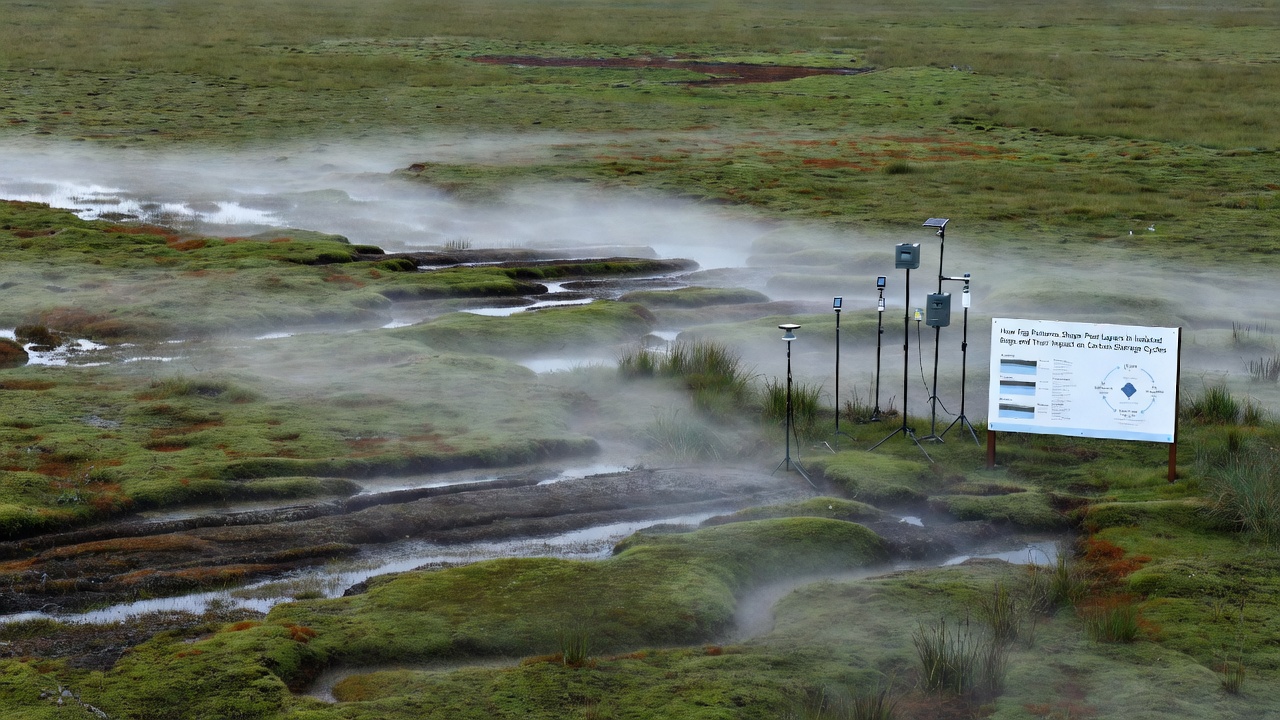
Scientists working in coastal and continental bogs use automated sensors to record fog liquid water content alongside peat temperature and gas fluxes, generating datasets that reveal how fog timing interacts with vegetation structure. In one watershed-scale project researchers documented that fog interception by hummock-forming mosses creates localized wet zones where decomposition slows dramatically, producing thicker peat lenses within broader flat areas. These spatial patterns matter because they determine the overall carbon density of the deposit and its resilience to future climate shifts. Equipment deployed since 2023 continues to collect hourly data, and additional instruments scheduled for installation will expand coverage beginning in September 2026 to capture interannual variability more precisely.
Further analysis combines satellite-derived fog frequency maps with ground-based peat cores, allowing extrapolation across unsampled isolated bogs. Results show that elevation gradients within single basins produce measurable differences in fog persistence, with lower sites retaining moisture longer and therefore building deeper carbon stores. Such findings align with reports issued by the United States Geological Survey on wetland carbon dynamics, confirming that atmospheric water inputs represent a first-order control on sequestration rates in precipitation-dependent systems.
Conclusion
Fog patterns govern the moisture regime that allows peat to form adn persist in isolated bogs, directly shaping layer thickness, decomposition rates, and the quantity of carbon retained over centuries. Continued measurement of fog frequency alongside peat stratigraphy provides the empirical basis for projecting how changes in atmospheric humidity will alter these carbon reservoirs. The interactions documented across multiple sites underscore the sensitivity of these ecosystems to small shifts in fog occurrence and duration.