Rosa Butler · 7 October 2026
Peatland Microbial Shifts Triggered by Transient Vapor Exposure in Upland Valleys
Peatlands in upland valleys host dense microbial communities that respond rapidly to changes in moisture and vapor conditions, and transient vapor exposure represents one such driver that alters bacterial and fungal populations within short timeframes. Researchers have documented these dynamics through field sampling and laboratory simulations where vapor pulses from fog or evaporative events reach the peat surface, and the resulting shifts often involve increased abundance of methanotrophic bacteria alongside declines in certain anaerobic decomposers. Data from multiple monitoring networks indicate that these changes affect greenhouse gas fluxes, particularly methane oxidation rates, while carbon storage processes remain tied to the stability of the microbial matrix beneath the surface.
Core Mechanisms of Vapor-Microbe Interactions
Transient vapor exposure occurs when atmospheric moisture condenses or evaporates over short periods, creating localized humidity gradients that penetrate the upper peat layers, and this process delivers oxygen and dissolved compounds that favor aerobic microbial groups over obligate anaerobes. Studies conducted in valley systems across northern latitudes show that even brief exposures lasting several hours can trigger gene expression changes in methane-cycling archaea, whereas longer or repeated events lead to community restructuring that persists for weeks. Observers note that upland valley topography amplifies these effects because cooler air drainage concentrates vapor near the peat surface, creating microhabitats where microbial activity intensifies.
Enzyme assays and metagenomic sequencing reveal that vapor pulses stimulate oxidative enzymes in fungi and bacteria, which in turn accelerate the breakdown of labile organic matter, and this activity releases substrates that neighboring microbial populations then consume. The net result appears in altered ratios of Gram-positive to Gram-negative bacteria, with the former often gaining ground after repeated vapor events because they tolerate fluctuating redox conditions more effectively.
Regional Patterns and Measurement Approaches
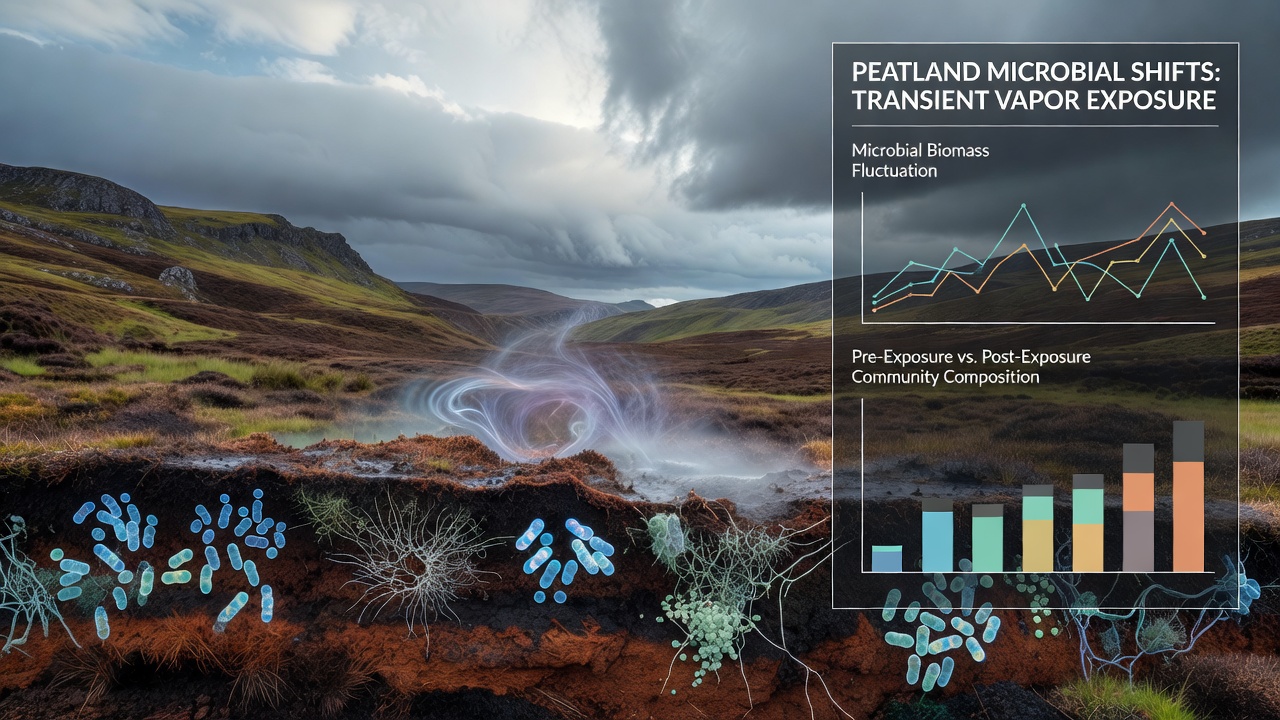
Monitoring programs in Canada and northern Europe have tracked vapor exposure events using automated sensors that record humidity spikes at 10-centimeter depth intervals, and results indicate stronger microbial responses in valleys with shallow water tables compared with those where drainage is more pronounced. In October 2026, a coordinated sampling campaign across sites in Alberta and Finland released datasets showing a 25 percent average increase in methanotroph relative abundance following a series of autumn fog events, while sulfate-reducing bacteria declined measurably in the same samples.
These findings align with earlier work from Australian alpine peat systems where vapor-driven oxidation fronts were mapped through stable isotope probing, demonstrating that carbon flow pathways shift toward greater mineralization when vapor exposure recurs seasonally. Equipment such as portable gas chambers and high-throughput sequencers allows researchers to quantify these transitions without disturbing the peat profile extensively, and integration of remote sensing data helps scale local observations to entire valley networks.
Consequences for Nutrient Cycling and Gas Exchange
Shifts in microbial composition directly influence nitrogen mineralization and phosphorus availability because certain vapor-stimulated taxa produce phosphatases and ammonifiers at higher rates, and downstream effects appear in plant nutrient uptake within the same valley catchments. Gas flux towers positioned in affected upland valleys record corresponding drops in net methane emission during and after vapor events, reflecting heightened consumption by the expanded methanotroph populations. At the same time, carbon dioxide efflux can rise temporarily as aerobic respiration increases, creating a short-term trade-off in the peatland carbon balance.
Longer-term records from valley transects suggest that repeated transient exposures may favor microbial consortia that lock carbon into more recalcitrant forms, although this outcome depends on the frequency and intensity of vapor pulses relative to rainfall inputs. Soil core incubations under controlled vapor regimes confirm that the direction and magnitude of these changes vary with peat chemistry, particularly the degree of decomposition already present in the matrix.
Links to Broader Environmental Monitoring
Agencies such as Environment and Climate Change Canada incorporate vapor exposure parameters into wetland condition assessments, while the European Environment Agency maintains parallel datasets that allow cross-continental comparison of microbial indicators. These coordinated efforts supply the baseline information needed to distinguish vapor-driven shifts from those caused by temperature or land-use changes alone.
Conclusion
Peatland microbial communities in upland valleys register clear compositional and functional responses to transient vapor exposure, with documented consequences for greenhouse gas fluxes and nutrient turnover. Continued measurement programs and integrated modeling will refine predictions of how these dynamics scale under changing atmospheric moisture patterns, and the resulting knowledge supports more accurate accounting of peatland contributions to regional carbon budgets.